MARTIAL ARTS

{R}EVOLUTION

No styles, no systems, no rituals, no lineages, no masters, no labels, no belts, no katas, no uniforms, no dogmas;

Only the process of self actualization & personal expression of truth through functional combative movement and fitness.

On a purely physical level, we share how to individually and collectively use all of our natural tools as well as extended ones, offensively and defensively in a strategic and tactical manner and in all ranges of combat.

We're put through functional physical fitness training where we learn to push ourselves through our own perceived limitations. We also have much to offer on nutrition, health and optimum performance.

On a more cerebral level we learn about the psychology of violence, fear, stress & confrontation management skills, deescalation strategies and holistic survival tactics.

As the mind navigates the body; by challenging personal self defense dogmas and individual & core belief systems, personal growth and evolution occurs.

On a human level, we learn about the ripple effect and the moral, legal, and ethical consequences of our chosen actions while self examining our darkest emotions. We are encouraged to question everything, to learn to think for ourselves, to be more accountable and research everything we learn and to be open and responsive to life without judgment.

On a personal level, the training can make you face and slay your own demons.

Everything shared here is highly encouraged to be individually researched, to “absorb what is useful, add what is specifically of your own and disregard the rest.”

Wednesday, August 10, 2011

It Depends....

Drilling how to take shoves, familiarizing one's self with the energy behind aggressive shoving, developing awareness and evasive footwork.
This was our primary reply to almost every question technical in nature since the very first Senshido class taught back in April of 1994. "It Depends". It frustrated most who were looking for absolutes and black and white answers.... sadly, there aren't many if any at all really...


The following article first appeared on The Senshido International Forum as I was inspired to write it after reading several threads which were very specific in nature.

It is critical to understand that there are no absolutes. There is no black and white in combat or defense, there rarely is ever an 'always' or 'never', there is nothing but an infinite amount of shades of grey, speculations, maybes and IT DEPENDS.

Getting smacked across the face as a humiliation tactic by Dom O'Neil playing the role of the bad guy.
How long does a street fight or violent confrontation last? 10 sec.? 25 sec.? A minute? A minute an a half? Honestly...? Who gives a shit? It will last as long as it will last... the question is, will you? How conditioned are you? Do you understand the effects of emotional and psychological stress and how it affects your performance and physical energy levels? What are you prepared to do?

Besides first and foremost offering a proper nutrition, not "diet" but a healthy all around nutritive lifestyle, I train my students to overkill. They are prepared to go 5 minutes straight if they have to, 10 minutes or half an hour if that is what it takes. They don't care if the average is 10 seconds or 3 minutes. That is a concern they don't have to even think about because they are prepared to go on and on until they are safe, whatever it takes.

I am often asked why our warm ups & workouts in our classes are so grueling, why I allow the fights to go on for 20 minutes non stop sometimes, why the overkill if a street fight only lasts X amount of seconds... because you simply never know. Prepare for the worst, prepare for the Terminator so everyone and everything else will literally pale in comparison.

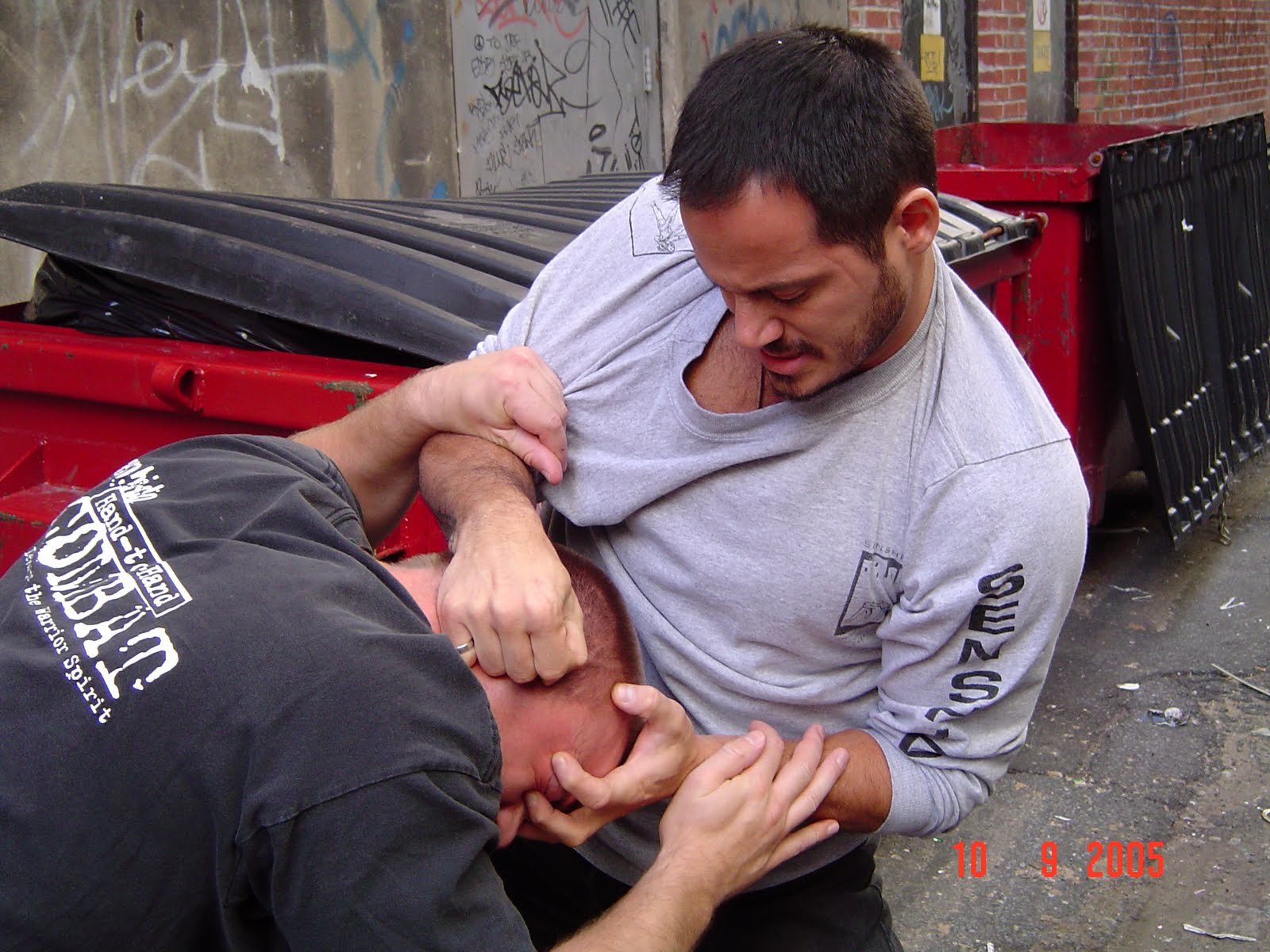
Working on the familiarization of aggressive body language and closest weapon to closest target interpretation on both the good guy and bad guy's part.

"When you throw a kick (or punch or strike or whatever you wish to insert here) where do you land after?"

It depends. What was your opponent’s reaction? Did your strike have the desired effect? What was the result of your choice? Di your opponent block the strike, did it land? Did he clinch afterwards? Did he defensively move away? Did he shake it off and pull a knife out?

Improvising the Shred moment to moment as my opponent reacts realistically to my every move and vice versa.
"When someone throws a straight punch, I was told to always move to the out-side and never to the in-side of my attacker, is this correct?"

It depends. Does your opponent have a friend standing on his out-side? Are you leaning against a wall which is 'his out-side'? Is the hand or arm you are 'supposes to' block, parry, jam whatever with functional that day? (I.e., is it in a sling, broken wrist maybe, sprained, tendonitis in the shoulder?) Is there a 25 foot drop on his out'side? What's the environment like?

Alive drilling allows spontaneous improvisation.
"When defending against a knife ALWAYS stabilize the weapon hand before attacking." - When defending against the knife, NEVER stabilize the weapon hand just attack, attack, attack!"

It depends. Where's the knife? Close, far, stabbing you? What is your opponent doing? Is it a static attack? Is it dynamic? Is he leading with the knife or coming at you Folsom prison style? Does he have a friend? Is his friend armed? How's your footwork today? 

Do you see what I am getting at here? There are no absolutes.

Maintaining facial targets while striking the lower line creates more sensory overload in the opponent.
"DO WHAT NEEDS TO BE DONE WHEN IT IS CALLED UPON." - Senshido Adage - This philosophy will help create clarity in the moment. Fixation on this or that may get you killed. There are no black and white answers. Defining the conceptual formula to each possibility is critical, the mind then creates the proper mental blueprints necessary to spontaneously improvise moment to moment.

Train your defenses in various scenarios to find out what you will do. Meaning: You want to work on defense against a static knife attack at the throat? Good. First work the principles and concepts, then the physical defenses until you are comfortable with them.

Next. Take that situation, the static knife attack, and do it under the following conditions:

1. You're alone.
2. A loved one is with you when it is occurring. (This one alone can be done in various ways, your loved one can become hysterical, cooperative, none cooperative, faint, scream, cry, grab your arm, hug you, threaten the mugger, etc.) each of these will require a different tactical solution.
3. Your attacker has a friend. (Again, you can play with this one, his friend is armed as well, his friend is passive, aggressive, drunk, hyperactive, trying to convince the mugger to just kill you and take your stuff, trying to convince the mugger to forget about it and just leave etc.)
4. Your good arm is an a sling. Your bad arm is in a sling.
5. Your left ankle is badly sprained (put thumb tacks in your shoes to simulate a sprain, see if you feel like putting weight on your ankle then )

The list can go and on and on... see if your "techniques" remains the same through out. See if the results are the same every time...

There are no absolutes.

Basic tool and target development, my opponent always dictates my response by his reactions.
This is why we do not teach techniques but conceptual guidelines and formulas, tool and target development, strategies and tactics. rather than provide people with technical skills to use in particular situations, we provide analytical skills that are useful in any situation.

Much peace,
Rich

Sunday, August 7, 2011

Senshido’s 5 Principles of Physical Retaliation

Applying the 5 principles of Physical Retaliation in close quarter equals SHREDDING!

Once struck, there are generally 5 different reactions a human being will have after getting struck.  The individual who has been struck can react in one or more of these ways.  In no particular order they are:

1.      To create distance.  The individual hit will back up and move away to regroup or protect themselves.
2.      To clinch.  The individual will close the distance and latch on defensively to the other who hit him.
3.      To counter strike.  The individual struck strikes back immediately (with or without a weapon), no quarter given on the counter. 
4.      Drops semi or fully unconscious.  The individual struck is put out of commission.
5.      Takes the shot, looks at you dead in the eye and replies: “That all you’ve got?”

Knowing and understanding these reactions are imperative in order to have a contingency plan for each and every one of them.  If your mind is trained to be prepared for any or a combination of any of these reactions, it will be extremely difficult to be caught off guard and one’s recovery time and natural flow are much quicker and with no hesitation. 

Your mind will be ready for whatever outcome and won’t go into the dreaded assumption frame.  One of the worst things one can do is assume.  The only 2 safe assumptions anyone can make in the face of potential violence is that 1. Your opponent is carrying a concealed weapon and 2. He’s not alone and he’s got friends. That’s it, that’s all.  Anything else can potentially get one killed.

The key in physical retaliation is your ability to spontaneously improvise your next move based on your attacker’s reaction.  Your attacker will always dictate what your next move is going to be based on the 5 possible reactions they will have after you landed your first strike.

The following are Senshido’s 5 principles of physical retaliation and they are always applicable regardless of what style or system one practices or what the scenario or situation may be. You will even find them applicable in the MMA arena.

Principle # 1.  Economy of motion. 

Musashi said, “Do nothing which is of no use”.  Basically, do not waste energy on unnecessary movement.  There are 2 ways of doing this. 1: Your intended natural weapon, whatever it may be whether it is a jab, kick or submission application should be the initial point of movement prior to any other part of the human body.  If your intended strike is a left jab then the left fist should be the very first thing to move followed by the rest of the body.  2: It’s important for you to have a mental and philosophical reason for everything that you do.  Don’t just throw a kick or punch for the sake of throwing it.  Many fighters as they circle each other feeling each other out will unnecessarily throw ‘something’ because nothing has happened yet.  If it is done with reason backed by strategy, then it is fine but a lot of times fighter’s just kick or punch for the sake of it. 

When my students spar, I will randomly stop them and ask them why they did what they did in terms of strike or combination, for the most part; they don’t have an answer.  It’s important for the student to understand and know why they are doing what they are doing.  This will economize on wasted motion and help the student strategize consistently while maintaining energy.

In the street, economy of motion also economizes on both mental and physical energy.  Energy is a key factor in survival.  For the most part, stress, fear and the adrenaline dump will cause a mental energy drain which in turn will deplete one of physical energy rather quickly. 

Principle # 2.  Non Telegraphic Movement.

Non telegraphic movement ties in directly with economy of motion.  This principle basically states not to telegraph your intention to your attacker by making any unnecessary movements prior to your initial attack.  This includes facial expressions, shift of body weight, shift of eyesight, idiosyncratic movements prior to striking and winding up.

Your attack should be explosive and sudden preferably from a verbal defusing stage where the body language is natural and non-threatening.  If you’re already engaged in the fight and your opponent is still ‘active’ your attack should still be explosive and sudden without any prior movement to initialize it except the intended weapon of choice (whether natural or weapon or actual weapon) and the ‘beat’ and ‘rhythm’ should be broken and erratic in nature.

Principle # 3.  Opportunity Striking VIA Closest weapon to closest target.

This principle dictates you striking without giving your opponent the opportunity to negate, block, jam, parry or counter your strike.  In order to do this you need to strike with (as Bruce Lee prophetically stated in an episode of long street) your nearest natural weapon to your opponent’s nearest open or available target. 

While doing this, repeat the word “Opportunity” to yourself as you begin your strike to the time you land your strike.  If you can say the word ‘opportunity’ more than once, chances are your opponent would have had the opportunity to react instinctively in negating your attempt to strike him and you did not use your closest natural weapon to their closest available target.  You should only be able to say the word ‘opportunity’ once at the most by the time you reach your intended target.


This doesn’t mean that your initial strike should be the knock out blow or strike that ends the fight, although that would be ideal, it isn’t always probable. For the most part, on the street, your first strike is a distraction or flinch instigator which will allow you to follow through with a more powerful or terminal (fight ender) strike.  Sometimes, a bite, pinch or spitting in the opponent’s face will cause a momentary distraction, which will allow you to capitalize on.  It’s important however, that when you follow up after your initial strike, you do so on the half beat so that your opponent doesn’t have the time to react and negate your follow up strike.

(This principle is demonstrated and instructed in full detail in our Surviving the Streets & Tool and Target DVDs available for purchase via orders@senshido.com)


Principle # 4. Primary Targets.

In a real fight, you need to end it as quickly as possible.  In order to do that, you have to debilitate your opponent.  However, it is necessary to judge whether the situation is a maximum potential for violence (life or death situation) or minimum potential of violence and weather or not your opponent is a good guy having a bad day or genuinely “bad guy”. 

 A maximum potential for violence situation requires use of extreme force.  The primary targets on the human body that will debilitate them are the eyes and throat.  As human beings, we have the innate instinct to protect our eyes and windpipe. If your opponent can’t see, he can’t fight, if he can’t breathe, he can’t fight.   The rest of the human body is secondary.  There are no other specific targets as there are nerve clusters everywhere on the human body.  Striking the groin, the sides of the biceps or the shin will all cause a flinch response creating another opening allowing for an immediate follow up strike.  Strike as many places and as often as necessary in order to reach the eyes and throat and debilitate your opponent.


If your opponent has been debilitated without having struck his eyes and throat then all the more power to you.  However, if your opponent is drug or alcohol induced or if he has a high threshold of pain, if he’s emotionally disturbed then chances are, if you haven’t struck his eyes or throat in order to reflexively protect himself, he’ll most probably keep coming at you.

Principle # 5.  Tactile Sensitivity.

Tactile sensitivity is the ability to interpret your opponent’s energy through the sense of touch. The majority of fights will start at the close quarter range also referred to as the trapping range.  Dialogue and communication will allow for an attacker to get in the close quarter range without necessarily having to strike you yet.  This is where the assailant has access to lapel grabs, strangulations, shoves, tackles, headlocks, static knife threats and attacks, intimidation tactics and more.  If the fight is not dealt with at this range it might well lead to the ground. 

Tactile sensitivity is applied the second you and your opponent have come into physical contact together.  At the close quarter, ground fighting and in close body to body boxing range the hand is much, much quicker than the eye.  If your opponent decides to pull a knife out of his belt or back pocket while in the clinch, you will not be able to see it but you will be able to feel and read his body language through the sense of touch.  There are countless drills that help develop the tactile senses and freestyle grappling on its own is a phenomenal way of doing so as you are constantly trying to interpret your opponent’s next move through the body to body contact. However pure grappling doesn’t offer the benefits of defending against strikes and weapons which should be added into all tactile sensitivity drilling.

A good tactile sense will allow one to defend oneself better at the close quarter and ground fighting ranges.  You’ll be able to feel and intercept an oncoming attack as it develops. 

There’s a story of a Tai Chi master whose tactile sensitivity was so developed that he had a butterfly in his hand try and fly away and he followed it with his hand until his arm could no longer extend upwards as the butterfly flew off.

Senshido’s 5 principles of physical retaliation are always applicable regardless of the situation or scenario once things have gotten physical.  They require proper training and mental blueprinting.  Once they are acquired however, they become unforgettable and imperishable skills, like riding a bike and applicable to all martial arts styles or systems. 

Train intelligently and diligently.

Rich Dimitri


Saturday, July 30, 2011

Brilliant kid

Wow. This 11 year old kid is more informed and intelligent than most adults I personally know.  How fuckin sad is that?  The information is out there folks, the truth is most definitely out there if you get off your lazy asses and take the time to research the things you put into your body.
DO SOME SHIT!!!!


Friday, July 29, 2011

A Shredder Drill

As described on the vid by Joe Saunders, Senshido International Team members Joe and Dom O'Neil demonstrate the face grappling drill at a Sydney seminar this past May 2011. The goal of the drill is to achieve dominant position and "Shred" your partner without being in a position to be Shredded yourself. It combines greco-roman positioning with an awareness of vital and vulnerable targets.  This is but phase 1 to a multi phase drill.  Though it is an isolation drill (working mainly the Shred in the clinch), it is still very much alive and dynamic:


Monday, July 25, 2011

A Thought Provoking Interview With Rich Dimitri


The following interview with Rich Dimitri was done by Anthony Colpo:
In Sheffield England with Belgium Team member in the black ACDS T-shirt muggin for the camera in the background; Rod Fiardi in November of 2008 after a workshop.
Those of you into reality-based self-defense (RSBD) have likely heard of Richard “Senshido” Dimitriseveral years ago he seemingly came out of nowhere to become a central figure in the RSBD arena, alongside well known figures like Tony Bauer and Geoff Thompson. Rich Dimitri’s rise has had little to do with clever advertising or crafty self-promotion – he doesn’t do any. Rather, his success is owed to the grassroots popularity of a highly effective fighting concept known as the “Shredder”.
In March of this year I had the pleasure of meeting and training with Rich (you can read all about the experience here).

I was so impressed, not just with Rich’s techniques, but the man himself, that I asked Rich if he’d be kind enough to do an interview. Rich graciously agreed, and what follows is the most revealing, in-depth interview this “underground” star of the RSBD world has ever given.
Prepare to have your beliefs challenged, for Rich Dimitri is a true maverick who speaks his mind and makes no apologies for it.
Please note this interview contains occasional use of strong language; if you’re a minor or easily offended by such language, please tune out now. For the rest of you, enjoy the ride!

Sunday, July 24, 2011

WE'D LIKE TO INVITE YOU TO SHARE THIS:

THEY SAY WE ARE AN IDEA... I LIKE THEIR IDEA, I AM ALL FOR THEIR IDEA AS LONG AS WE MAINTAIN A PEACEFUL AND NON-VIOLENT REVOLUTION, I, WE, ABSOLUTELY DO NOT CONDONE ANY VIOLENCE WHATSOEVER OTHER THAN IN DIRECT DEFENSE OF A DIRECT ATTACK.  WITH THAT SAID, THIS MESSAGE IS ABSOLUTELY BRILLIANT:


Sunday, July 17, 2011

The story of Human Rights


Compare that too......


Now Laugh your fuckin asses off....

The war you won't see on your telly....

The unglorified, unglamorized, harsh realities you won't see on your television news:


This is the non sugar coated 'we fight for our freedom' bullshit war they're selling us.  Some people claim that videos like these are "agenda" based and driven.... the only agenda I see here is the agenda of PEACE.... not a bad fuckin agenda if you ask me.... compared to what you see in that clip? I'll take that agenda.... 2 please MUTHA FACKOS!!!!

Share this clip. Unless of course you don't agree with it. Then don't bother sharing it. Otherwise, if you please....do some....

Saturday, July 16, 2011

I don't necessarily agree with nor believe everything said on the clips/news-bits I am providing.

I am posting to provoke thought. There is something indeed wrong with the world today and self defense begins with the self and encompasses a fuck load more than beating up the mugger/rapist/criminal. 


If something doesn't look right, if the status quo of things doesn't appeal to you, if something seems fucked up.... QUESTION AND DO SOME SHIT!

If people violently oppose something, label you, try to put you in a faction for questioning shit, then you should be QUESTIONING THINGS EVEN MORE....

If bullshit, inconsistencies, coincidences, repetitive circumstances and violent opposition to question is happening around you, voice your opinions, speak your minds and FUCK those who try to quiet you by labeling you or placing you in any kind of faction.... 

Keep asking the hard questions, keep fucking pressuring for logic until the answers begin to make sense, this is how CHANGE HAPPENS!

DO SOME SHIT!